“How Far I’ll go (Reprise)” from Disney’s Moana sung by Auli’i Cravalho
If you came here to watch the video of how I made the Disney Planner with Claude Code and Claude Design, but not read the full backstory, you can see the quick walkthrough below.
It has been a roller coaster the last 4 years with LLMs. I remember when I first explored ChatGPT in ’22 I wrote “ChatGPT, Make Better Architecture, but Don’t Approve PRs Yet,” the most read post on this blog. It said…
Perhaps if we feed ChatGPT screenshots of code it will learn the value of pull requests to guide CEOs based on the user logged into its account. Perhaps it will benefit from being fed comments from Git. Someday ChatGPT and others like it may close the delta between what one can use in production and what is only, a microcosm of complexity that lies in stacks enterprises manage today, adopt an extremist view of GitOps, write its own code, and self-deploy. But probably not.
I was wrong.
People are vibe coding straight into AWS having no experience with databases, microservices, serverless, kubernetes and trusting whatever the output AI gives them – which is only as good as what they know. As cloud operations teams try to prevent regression (and reversion?) from those who are picking up the cloud we’re learning a whole lot about each other’s job functions – it is easy to think the other person’s job is easy.
Here’s my view on that – I’m fine with it. We are going to break production. Finally – some of those most scared about breaking production are going to learn what it means to do so, how it impacts the people who operate it everyday, and truly learn the value of fast feedback loops, the time investment into security isolation – the hard parts. That being on-call for our own work is the job. If you build it, you run it.
Practice Your Moral Compass
I spoke a few weeks ago to students at my alma mater Savannah College of Art & Design. AI was a hot topic and I answered honestly – I use it everyday. This post is one example of how I’ve used it at home but I’ll share more projects over the coming weeks that are outside of work.
Let’s start with the budget – I spend $20/Month for a Claude Pro subscription. This gets me most of what I need at home because I spend 8+ hours a day at work. I have more recently also bought some Claude API credits for a specific hobby project I’ll share in the future. If you are a student this investment is worth it because you get access to Claude Code, Claude Design, and you can truly learn how these tools work.
I have written authentically on this blog about my views on AI – including how the definitions of manager, engineer, and companies operate have changed. I do have a lot of negative feelings towards the tooling (both technical frustrations and moral frustrations), but when I speak to students I often see either “Pro-AI” or “Anti-AI” stances.
There is a middle ground to walk here. It is worth noting, LLMs are not the only use case for AI – so if the issue is strictly with Gen AI or LLMs – understand that there is a whole world out there of other use cases that have been around for decades. It is not okay to move forward in this future and ignore it. It is not okay to not practice, learn, and understand what is out there. You can choose where that line is for you. For example, I do not let AI write drafts for this blog – I have tried it and it killed my voice.
And finally in my explorations, while I have found immense value in using AI and I genuinely love the experience of using CLI-based interactions with MCPs, Skills, and it has helped so much to investigate logs, alerts, and troubleshoot in production, I genuinely do not feel like most of what I do with it is coding. Coding, as Kelsey Hightower has elegantly put in his entire career, is the hard way. There are many, many times in your career to do the hard way and it is the best way to truly learn.
For example – I was thinking about rewriting a script in another language that I didn’t know well. I couldn’t feel confident in the AI writing that for me – I would have preferred to learn the language first, then have the AI rewrite the script. So I have AI write in what I know until I hit a learning gap where I want to learn the hard way.
This project was me learning what I wanted to use AI for and has been a hobby over the last few months.
Why I Built the Disney Planner
The Disney Planner was built because I wanted to plan a future Disney trip for my family – my husband has never been. His mom has never been. My daughter will have never been and I have not been in over thirty years. When we go, it will be a big moment for us; however – not only do I not know when I want to go, I don’t know how much everything costs so I designed a planner that replaces what I would have built instead – a giant Google Doc and spreadsheets. Yuck.
Claude all the Way Through: The End-to-End Process
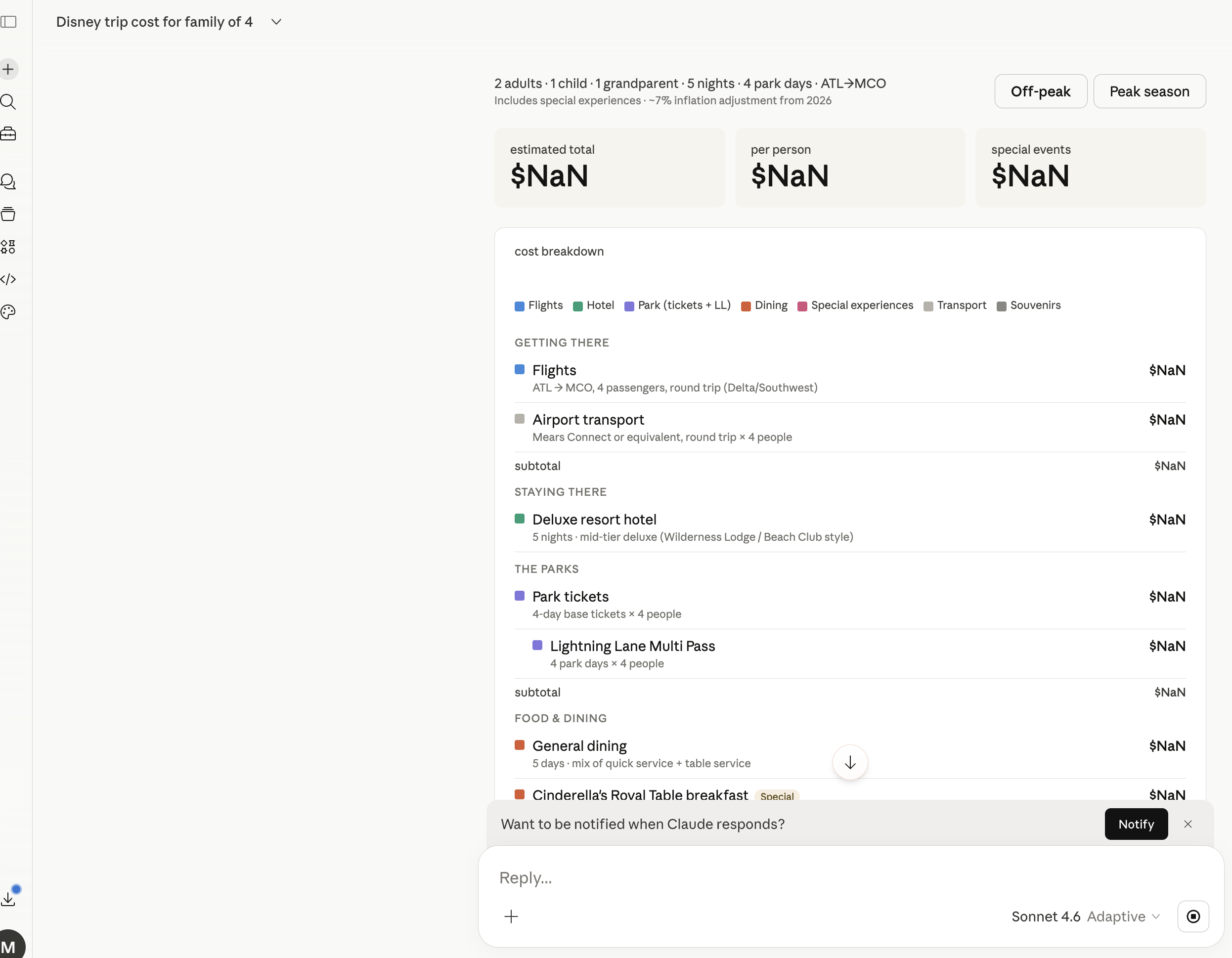
Step 1 – Claude Web: I first started with a simple artifact in Claude Web. It was structurally gross. It started off okay until I tried to build features which bloated the artifact so much that bug after bug appeared. There is a point where you can tell you need to make a proper repo. Claude Web is great for an initial concept that you don’t plan to update. Visually it was only slightly better than a spreadsheet. I shared it on LinkedIn and immediately thought…this doesn’t end here.
For example – the Claude Web UI started breaking as it could no longer handle the artifact – and you know there is something deeply wrong when your estimated Disney Total comes up as $NaN.
This is where I got some amazing feedback from Jennifer Caprano, who is an industry and company colleague that moonlights as a Disney Agent for friends as a hobby. She said I was missing deals. Doh! Of course – I’d love to factor in a 20% decrease!!
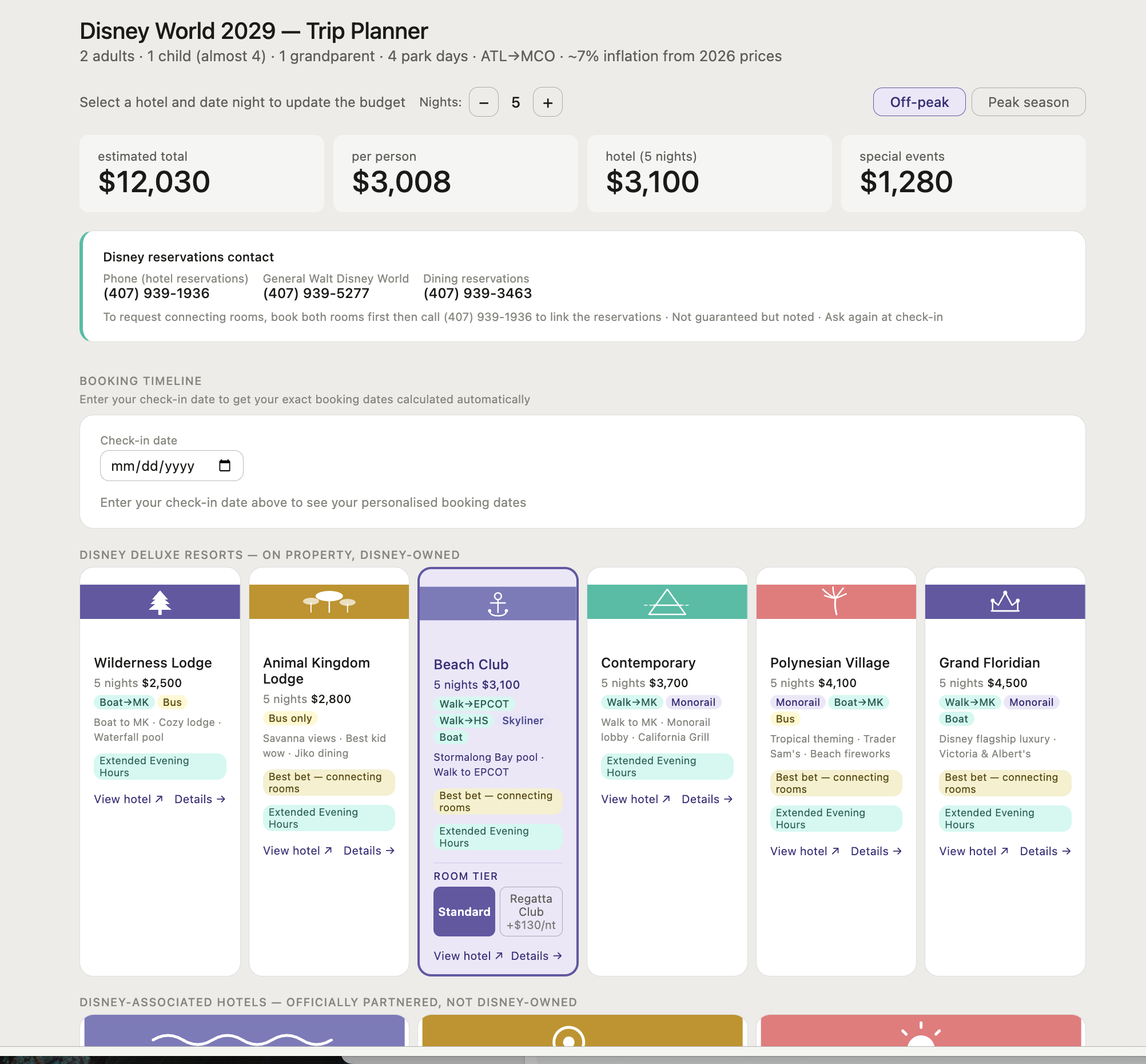
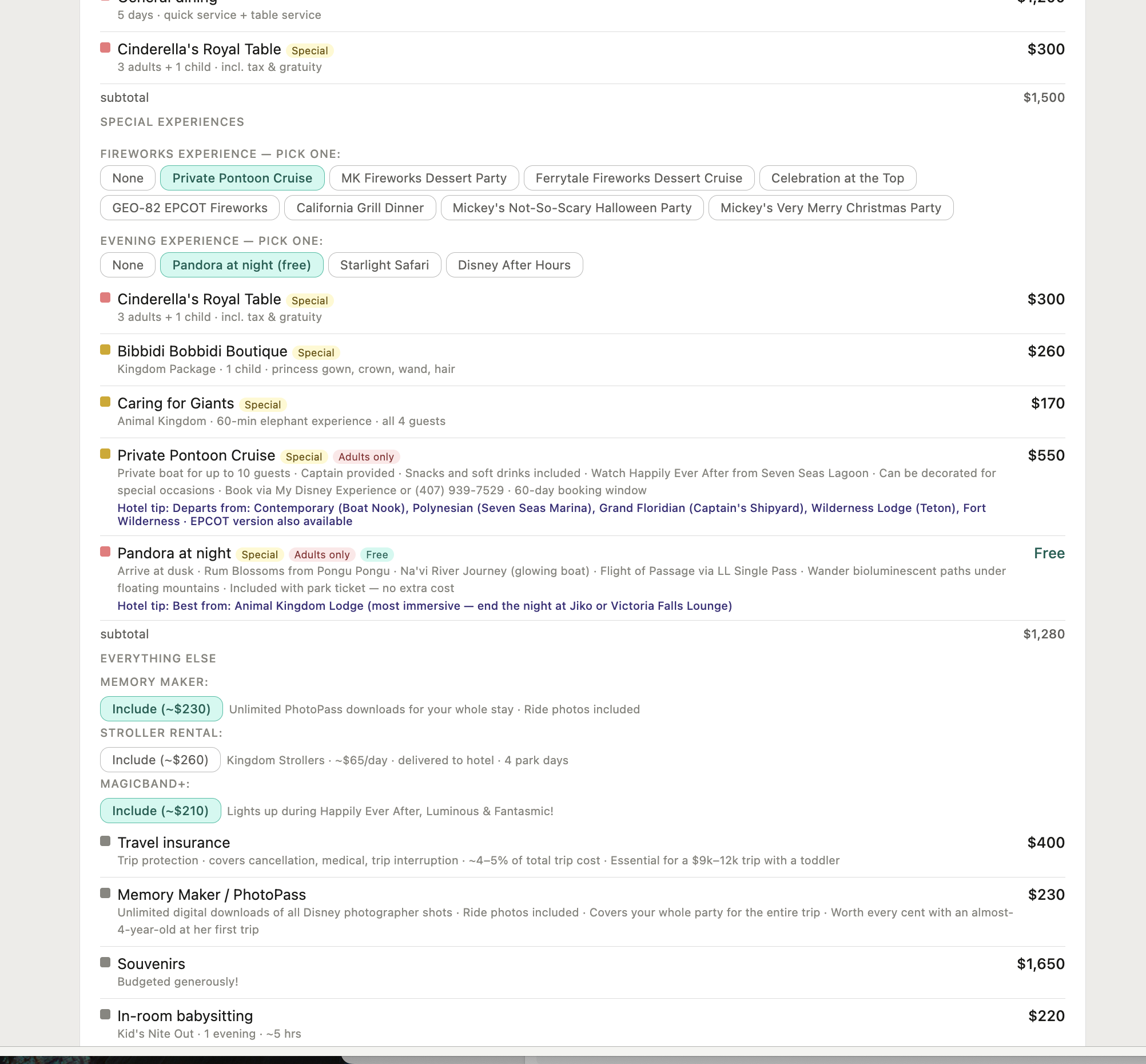
Step 2 – Claude Code: I brought it into Claude Code and immediately told it to bust up the artifact into a proper set of web files. I had it rewrite the entire project in React. I put it in a proper Git Repo and added documentation. But also, I saw how Sonnet was beginning to fail me. I caused some serious bugs that were math based – for example, the inflation feature, which inflates prices of Disney related costs like hotels, tickets, and events – as you increased inflation would decrease costs. LORD, I wish!
Things got immediately better in Claude Code – bugs were easier to find. I could read the actual logic behind the entire project. It was split up so it was no longer one giant file. Then…Claude Design came out.
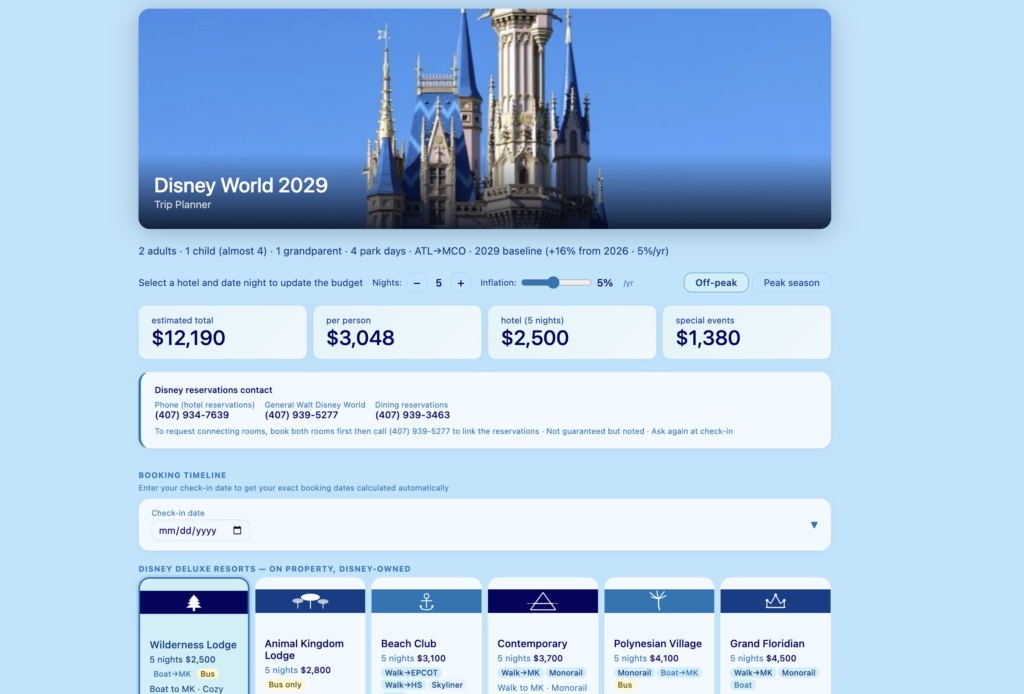
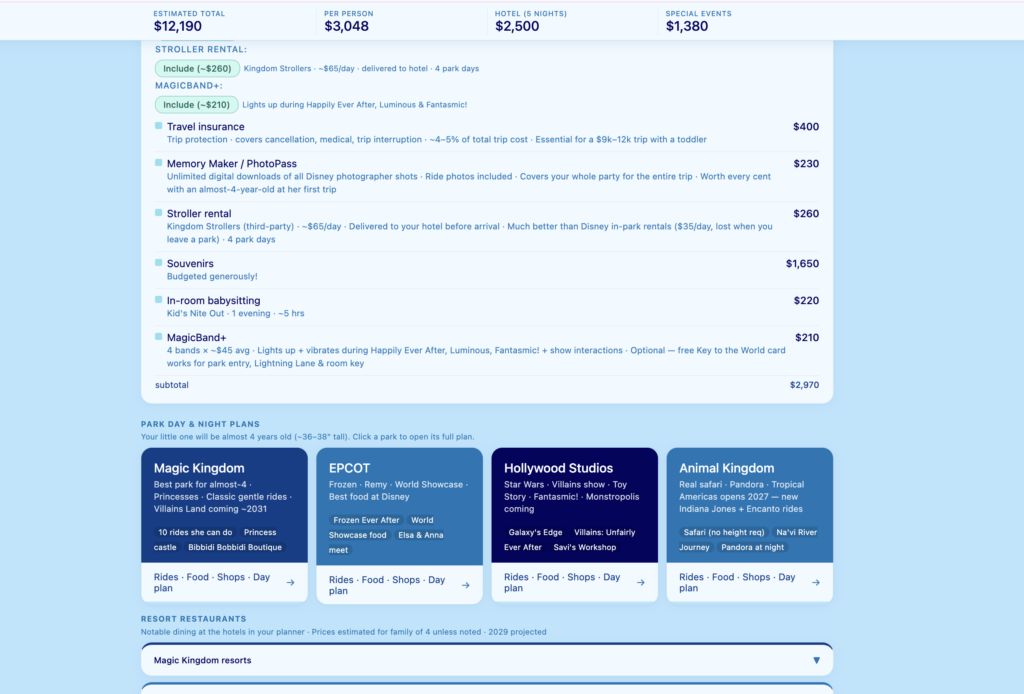
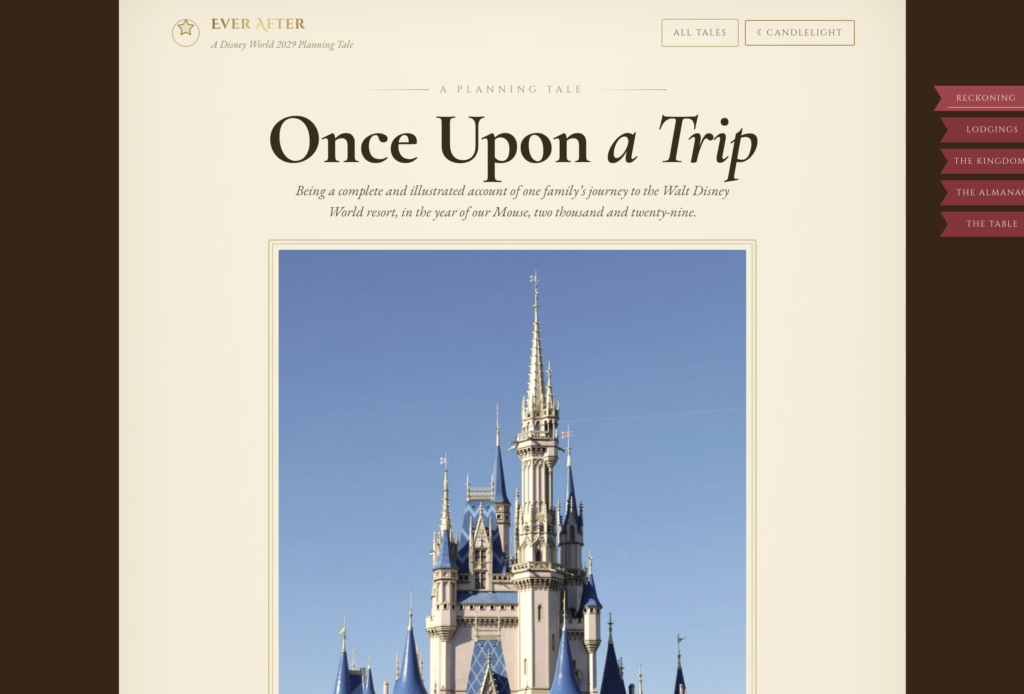
Step 3 – Claude Design and Opus: I immediately wanted to jump on this because I still pay for Adobe Photoshop and other tooling. While that used to be something I used more regularly 10+ years ago, these days I do not. I was thinking – is it good enough to replace Photoshop for me? Yes, for me it is. For artists and UI/UX folks in their day jobs probably not.
Claude Design was magical – you can attach an entire repo to it and it will go from there. I wrote a prompt asking to make several beautiful design options – one book themed and one enchanted. When it described back what it was going to do for the enchanting version – something along the lines of full sparkles, lots of fireworks, glitter everywhere, mouse trails – I immediately thought “This theme is about to be GeoSh*tties.” I am pleased to say I was very wrong. It did an amazing job. It even gave me a slider for just how absurd I wanted it to get with the glitter-sparkle-rainbow-magical-agenda and because I needed to fuck-around-and-find out we turned that up to 11.
But it ate 100% of my usage budget in an hour. Thanks Opus!
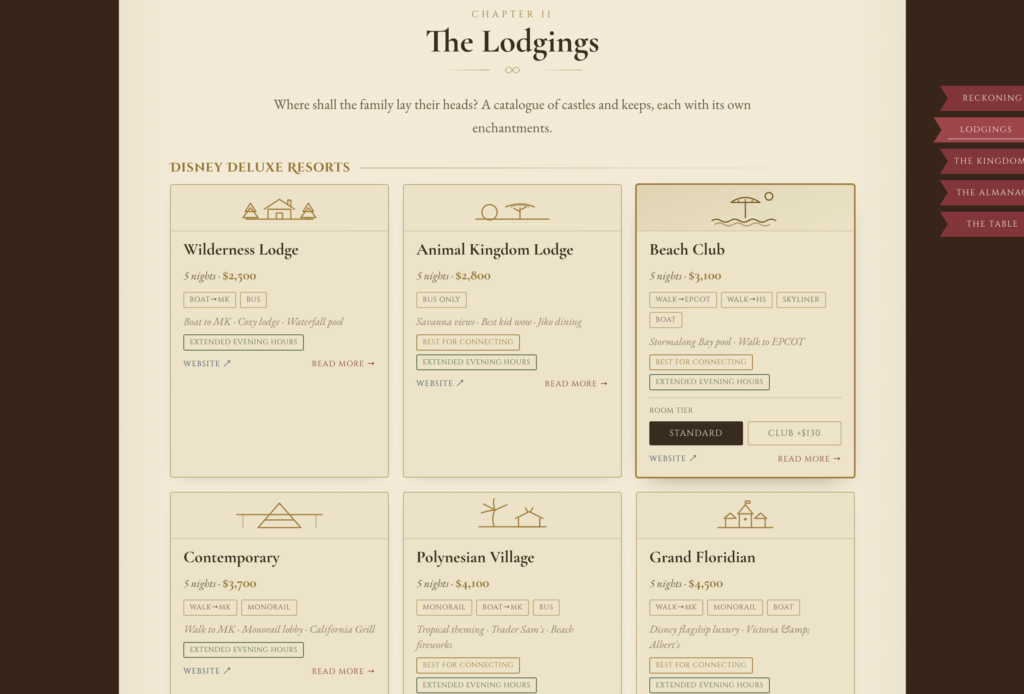
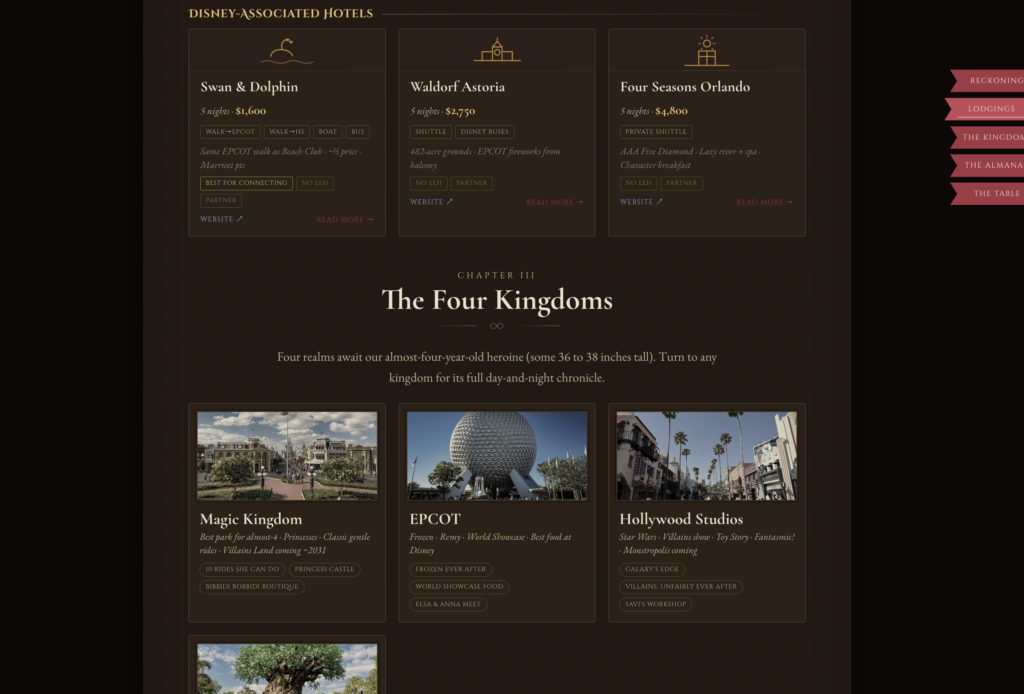
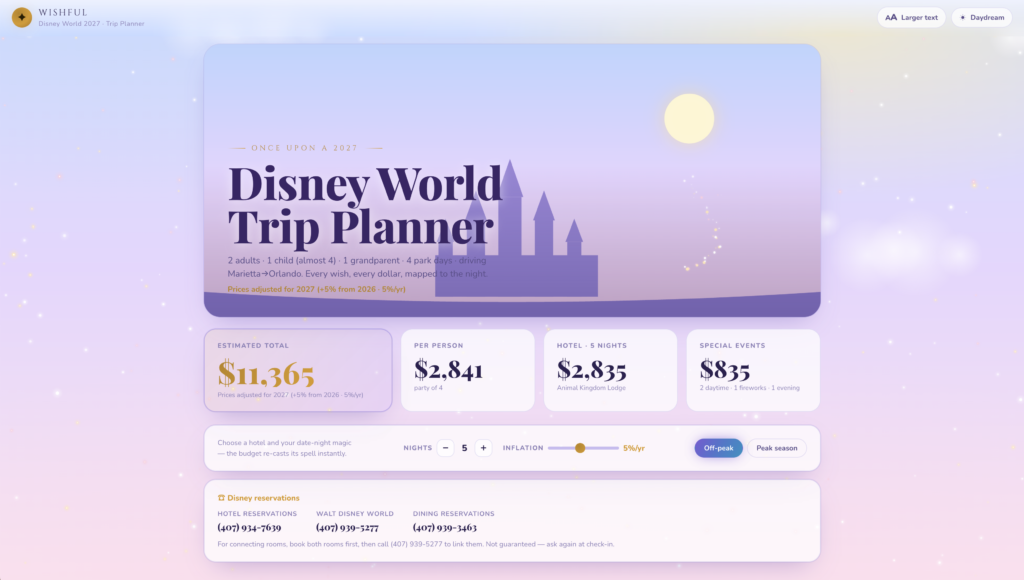
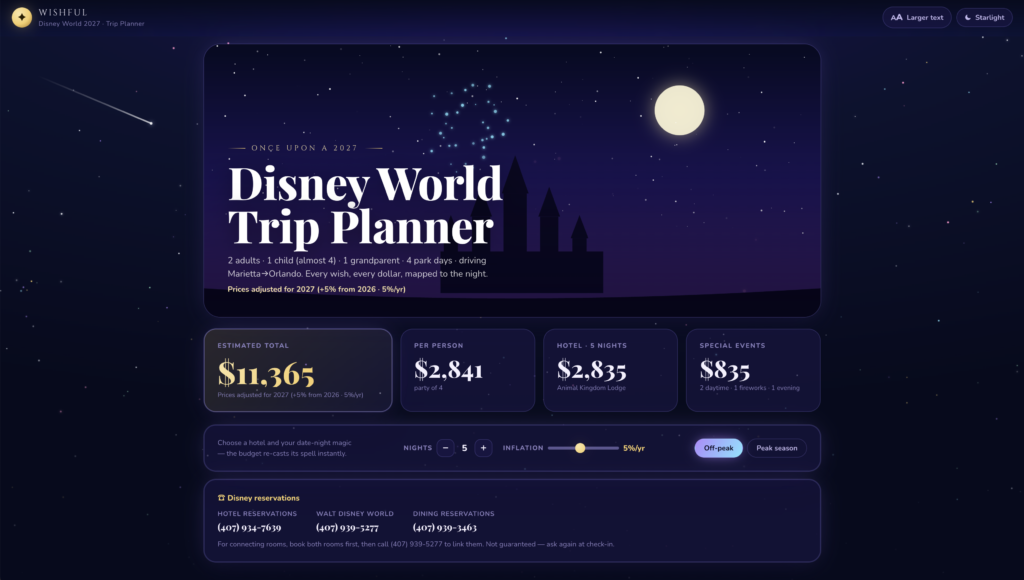
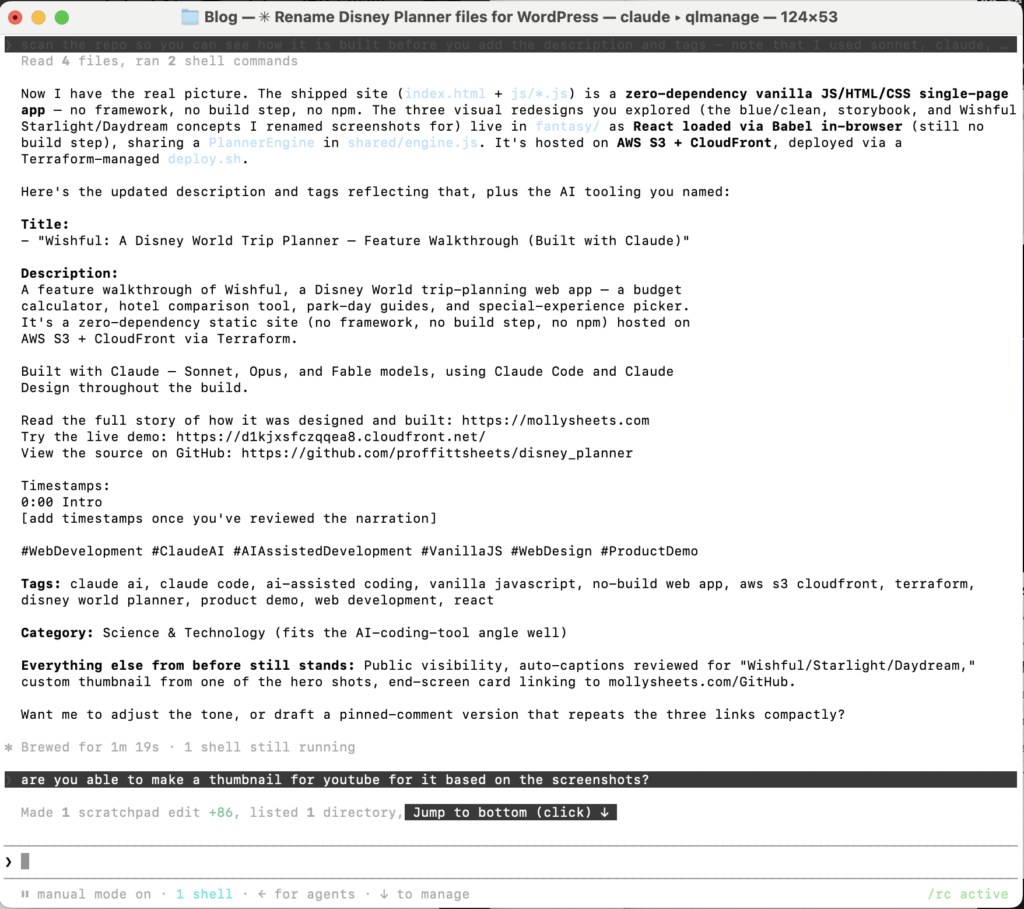
Step 4 – Back to Claude Code..but with Fable?: I wrote some Terraform, or rather I got Claude to write it, to build be a proper hosting solution for this. It’s extremely simple – S3 + CloudFront. If I build enough projects like this I may host them all in a different way but this works because “buckets” as a concept are free, only the storage isn’t. I try to keep my AWS bill in general under $30/month on average and budget $100/month.
I ended up liking the “Wishful” theme it built and brought it back into Claude Code. A few weeks later Fable came out and I had Fable scan every hobby project I own for, you guessed it, bugs. I went on a bug-fixing-fable-rampage and it was marvelous. I also built a complete financial portfolio analysis projection across stocks, but that’s another story, for another time (It’s good at math?!).
Step 5 – Claude for Everything: I didn’t stop there – I wanted a video demo. I wanted a header for this blog. I wanted every description I needed for YouTube and the right hashtags as someone who isn’t a social media manager. And I got it.
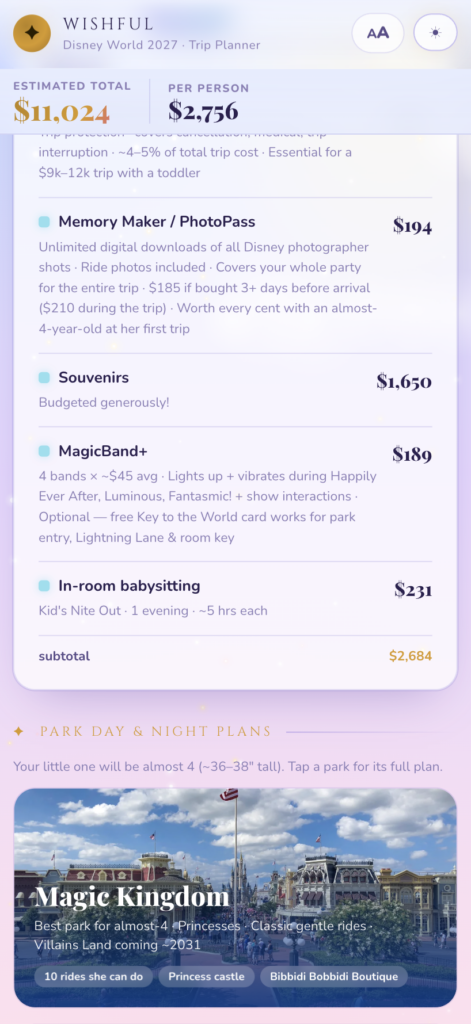
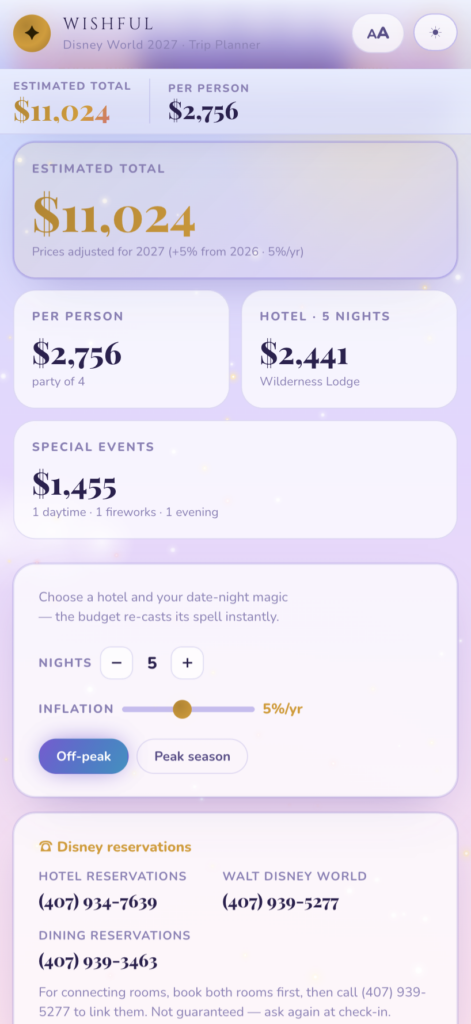
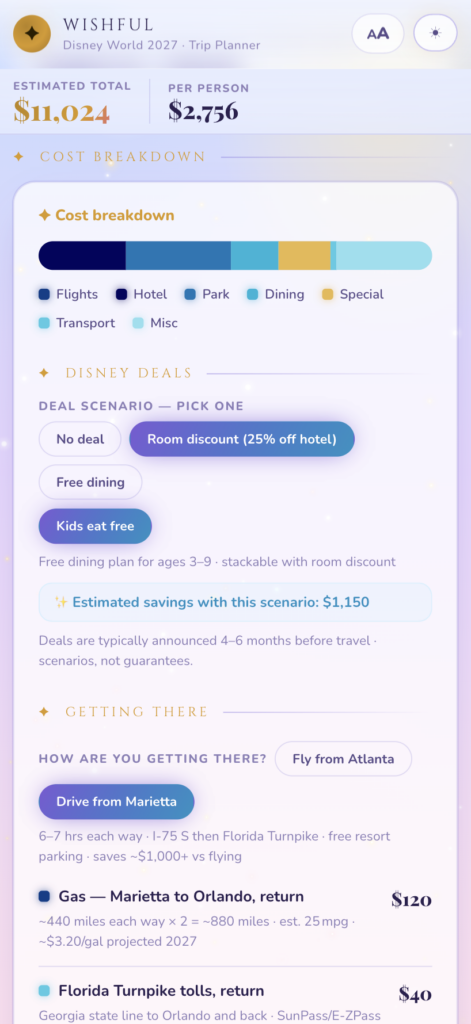
The End Result Is Magical And Mobile Friendly
You can visit the website hosted at https://d1kjxsfczqqea8.cloudfront.net/ and also see the repo here https://github.com/proffittsheets/disney_planner.
Clone it, Fork it, build whatever you want with it and make it yours. But I will not fix your bugs and I do not guarantee any of the prices as they are predictive.



I am not going to say the code is perfect. It lands somewhere between vibe-coded and smart, but also I understand what it wrote because it’s dead simple, it has a frontend so you can test it easily unlike things that do not have visuals and live in production crying out bad logs everyday. I saw it was broken on mobile and had to fix that and instead of having to chase down a bunch of reasons why it didn’t work on X device it was…easy. It tried to use an old version of Terraform and spin up an Amazon DynamoDB database to which I said no please, why aren’t you using S3 state locks?


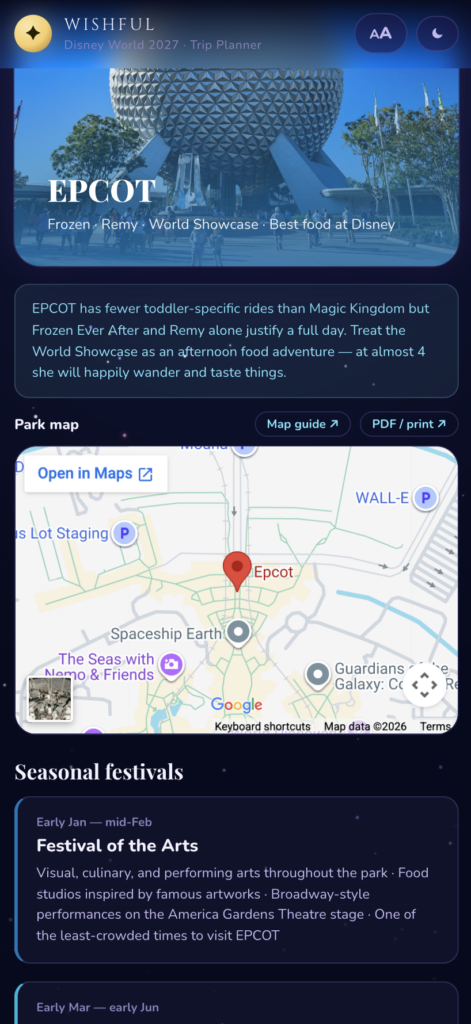
I had to explain that I wanted to make the repo public and release with the MIT License so it wouldn’t store my bucket name as a public “secret.” I, in no way, feel confident to just let AI do everything and auto-deploy its first pass to customers. I want myself in the loop at different steps.
Both Fable and Opus by the way love to go on bug-finding tangents even when you are fixing something completely different – it’s good and bad, and you can read about it in the documentation. In another project where I was trying to build a resource scanning script it started to try to fix a real public bug in the latest version of Python instead of thinking, wait that isn’t the goal right now. Walking away from your computer can land at you spending thousands of tokens on fixing an OSS problem instead of building the features you wanted…or in addition to it, but you paid for it and never asked.
Would I do this again instead of a spreadsheet? Absolutely.
Can I afford Disney in a few years? We’ll make the dream happen someway. But for now, it is a dream until I have the patience of a parent who is bringing a toddler to Disney.