“Maybe the Best is Now” by Judah and the Lion
I’ve learned that my toddler loves owls. She thinks 2 of them live in the stairs.
I thought “Let’s make her some” and generated so many with Gemini she now thinks my computer is exclusively dedicated to it.
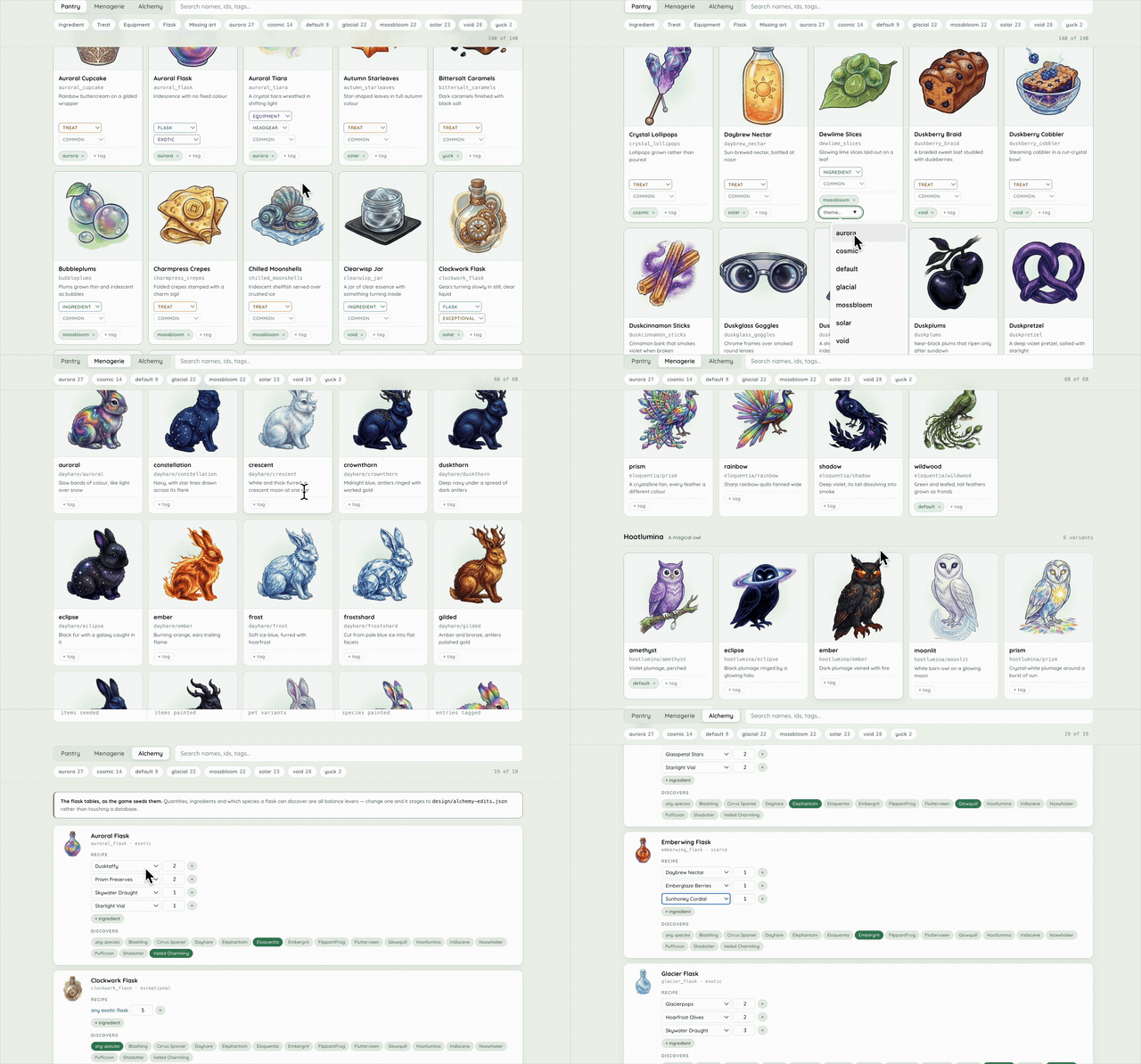
I have to hide “my Owlbook” otherwise she points, yells “OWLSSS!!!!” and starts having a tantrum when I don’t bring up the database tool for managing all of them. Any reasonable person would say “You’ve clocked too many hours on this.”
I thought “Why stop there?” What if we could build a game better with AI – what if we didn’t rely on the big engines. What if we tried to use full OSS? What if we didn’t use Godot? What if the engine didn’t make all our decisions. Let’s go rogue. My excuse? I need more owls and they need to live somewhere and do things for her.
The problem with releasing a real game is you do actually have to care about the end user client and the distribution platform… and all the pipelines for art assets; but I am interested in a world where HTML5 games are the backbone of future experiences and every binary isn’t some .exe or .apk or .ipa. So I set out to use Claude Code, Claude Design, and Gemini to build a game in Rust and Tauri. Touching the frontend in anyway should be a clear indicator that I am starting to become bored.
Meet Wonderlum: A Placeholder Name For the Nostalgic
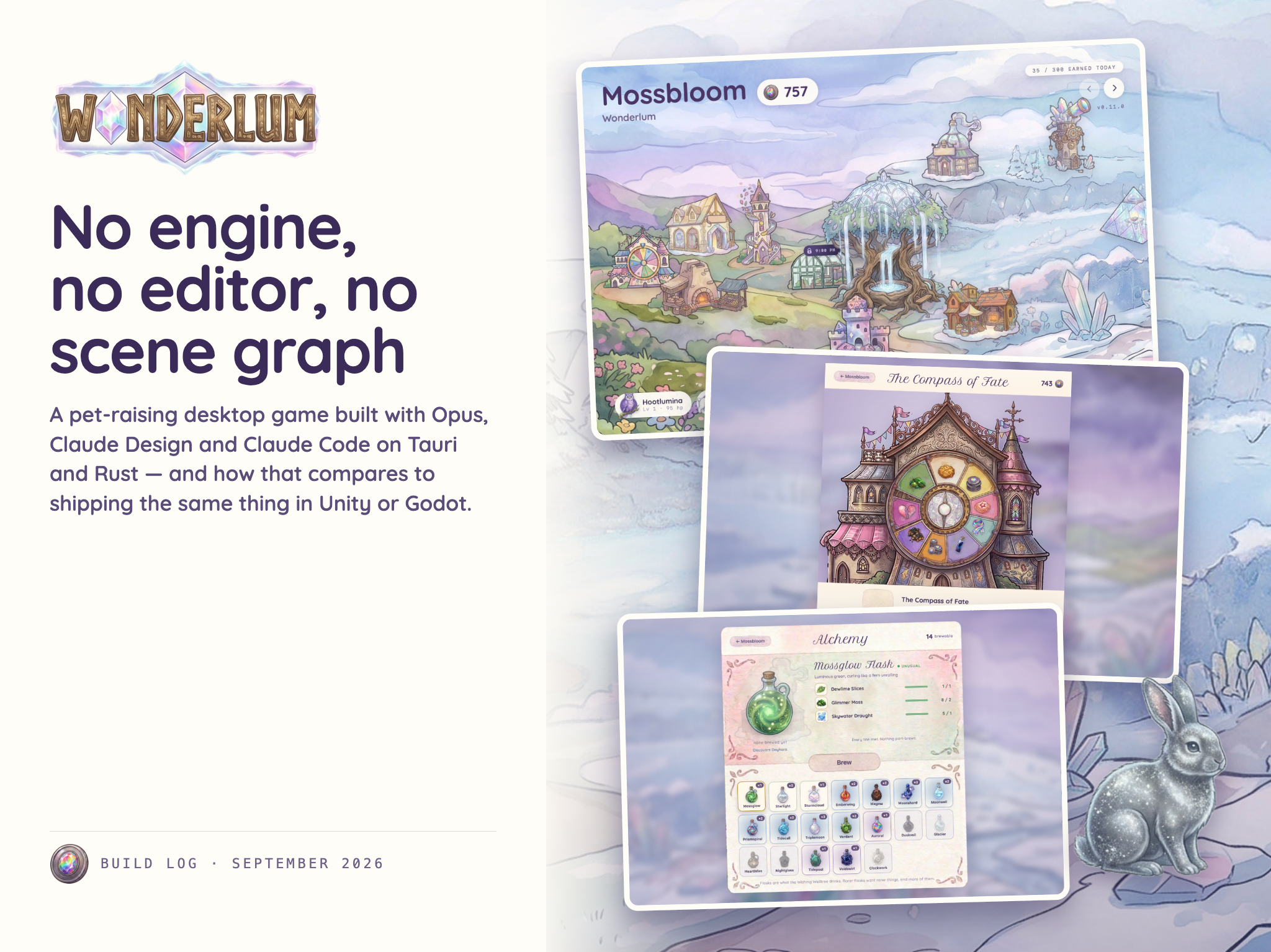
Wonderlum is a cross-mini-game ecosystem where players can discover too many owls, but also 14 other species and subgenus as pets in the land of Mossbloom.
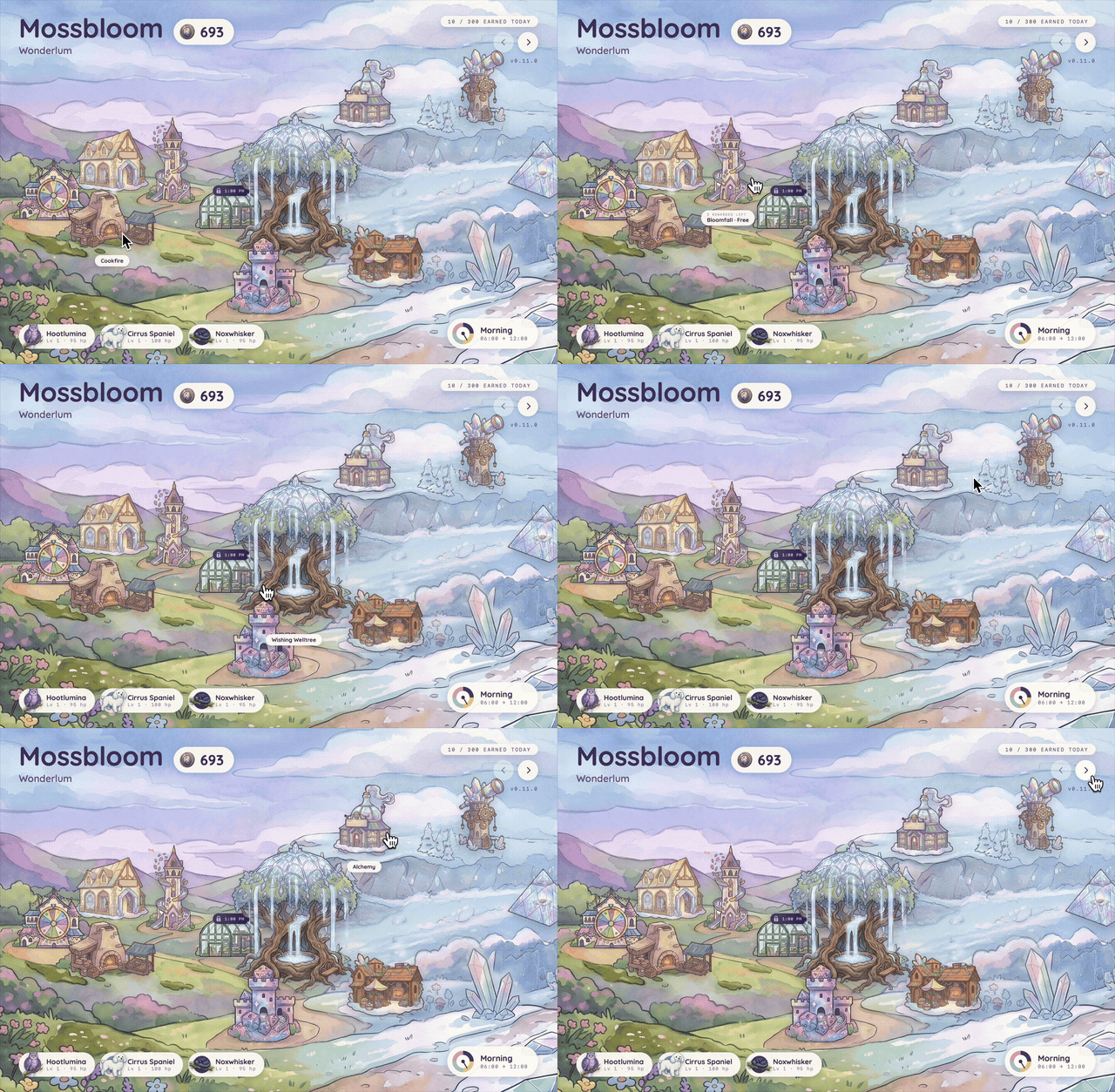
The art style, thanks Gemini, is engineer-watercolor. It is inspired by my love of the UI and artistic style of Guild Wars 2, Wingspan (and Wyrmspan), and Hades 2. The dream would be to have an artist go in the general direction of watercolor and magic, invent something new, instead of this hodgepodge of Gemini generated art. It would be nice if each special experience had unique framing and fully embodied a story they told. That said, you could have had boxes, and I thought it would be hilarious to set the bar for placeholder art high.
I had to relearn cutting out art assets (ugh) and discovered Firefly along the way in Photoshop. Let me tell you – we have a long way to go when it comes to AI not being bolted on to art workflows. The object selection tool + export > layers to files will get you close enough so that you can cut even more gross corners in Claude.
For example, I now have an offset table for my placeholder art that Claude had to write because I was too lazy to individually organize 100s of assets like a real artist and some of the night and day versions of the buildings are not exact to each other. I’m telling you, this repo is a mullet – business in the frontend, party in the rust.
This path of individually generated art assets in Gemini per purpose > Photoshop > Back to Tauri leads you to start to notice the uncanny valley of AI art not fitting together – what a real artist solves. It’s good enough for a prototype – and the expectation of Alpha went from “you are allowed to have triangles” to “why didn’t you take 5 minutes to create a building for that” to “throw it into Claude Design to at least have some feedback for button clicks.”
I was interested in how fast Claude could take a design doc for a feature, iterate on it via Claude in VS Code + Terminal, and then have Claude Design ref that and any existing art to create feedback animations. This was both a fun but also pain-oriented loop. Because Claude Code > Claude Design > VS Code > Tauri is not a closed loop game engine I was shuffling all over. It was the horrific experience of trying to use Unity without real-time Play Mode UI (game view) or a scene graph – a cruel joke you should only put on your friends on April 1st.
In an ideal world we’d have a net new game engine for “partially AI generated” games that let you close the loop on these things while also then swinging back around with a real artist who could take your iffy placeholder art and replace it with a brain, beauty, and originality. I worry though that due to games being complex and a mix of styles, features, and pipelines that no one should invest in this idea unless they can predict what future games will actually make money in this god-has-left-us-industry.
In a less somber note, testing has been an interesting experience. I love that Claude with Opus will write tests. However it tests using the Claude-in-Browser plugin which is interesting because the desktop is a Rust shell over the OS layer and the database doesn’t work in browser as the player save is SQLite using the Tauri plugin for it. Which means I am going to have to have Claude write a different way to manage the database in browser. Imagine managing both of these systems before AI. I’ll wait.
We have a lot of education left to explain that none of this is a one-shot. Not even close. I don’t want to play a game that was a one-shot of an AI prompt anyway.
The Game Design
I hoped to bring feelings of the good ole’ times from Neopets (circa 1999 version) but mixed with the unpredictable discovery of Monster Rancher where every new physical disc let you discover something new.
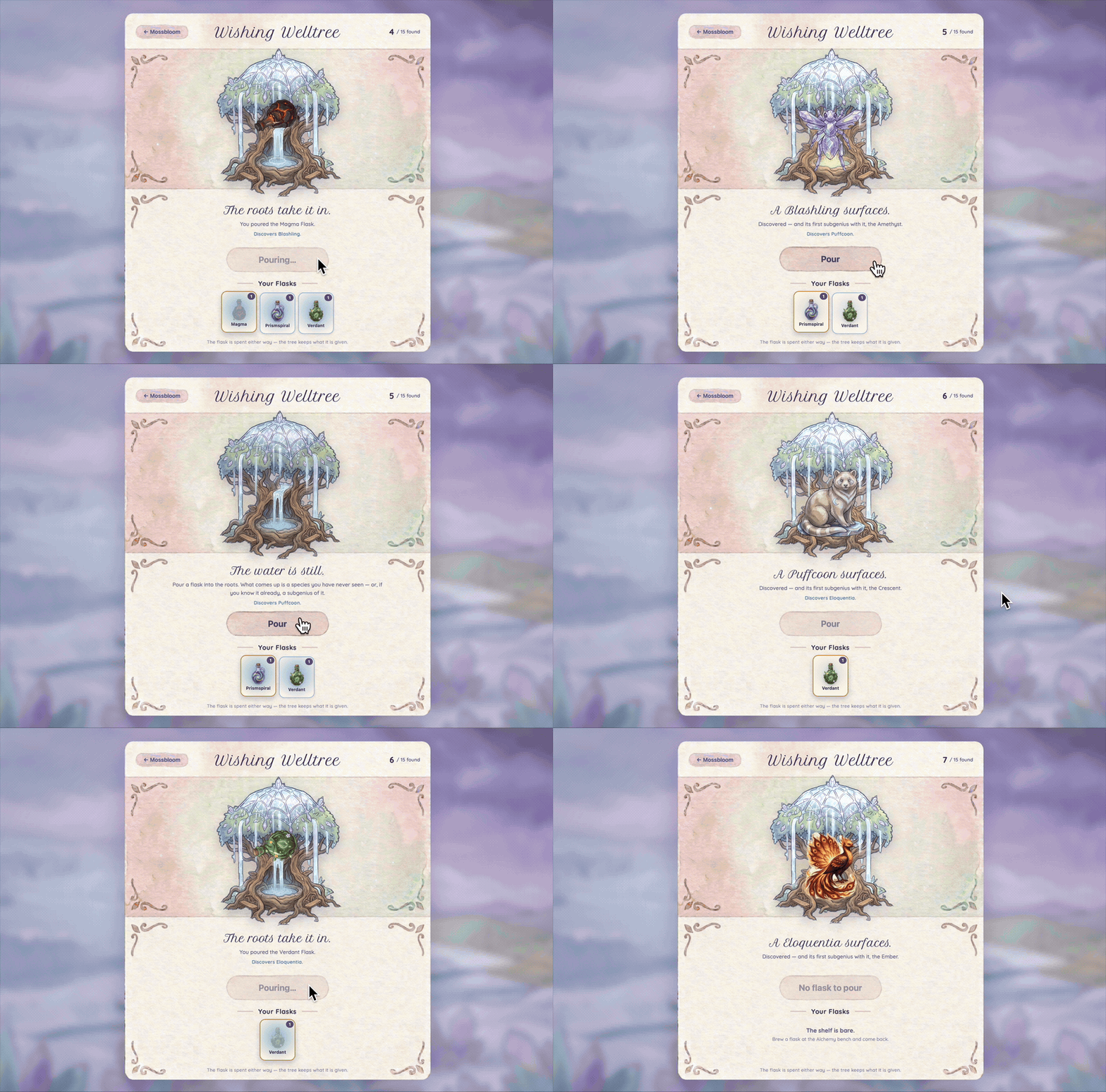
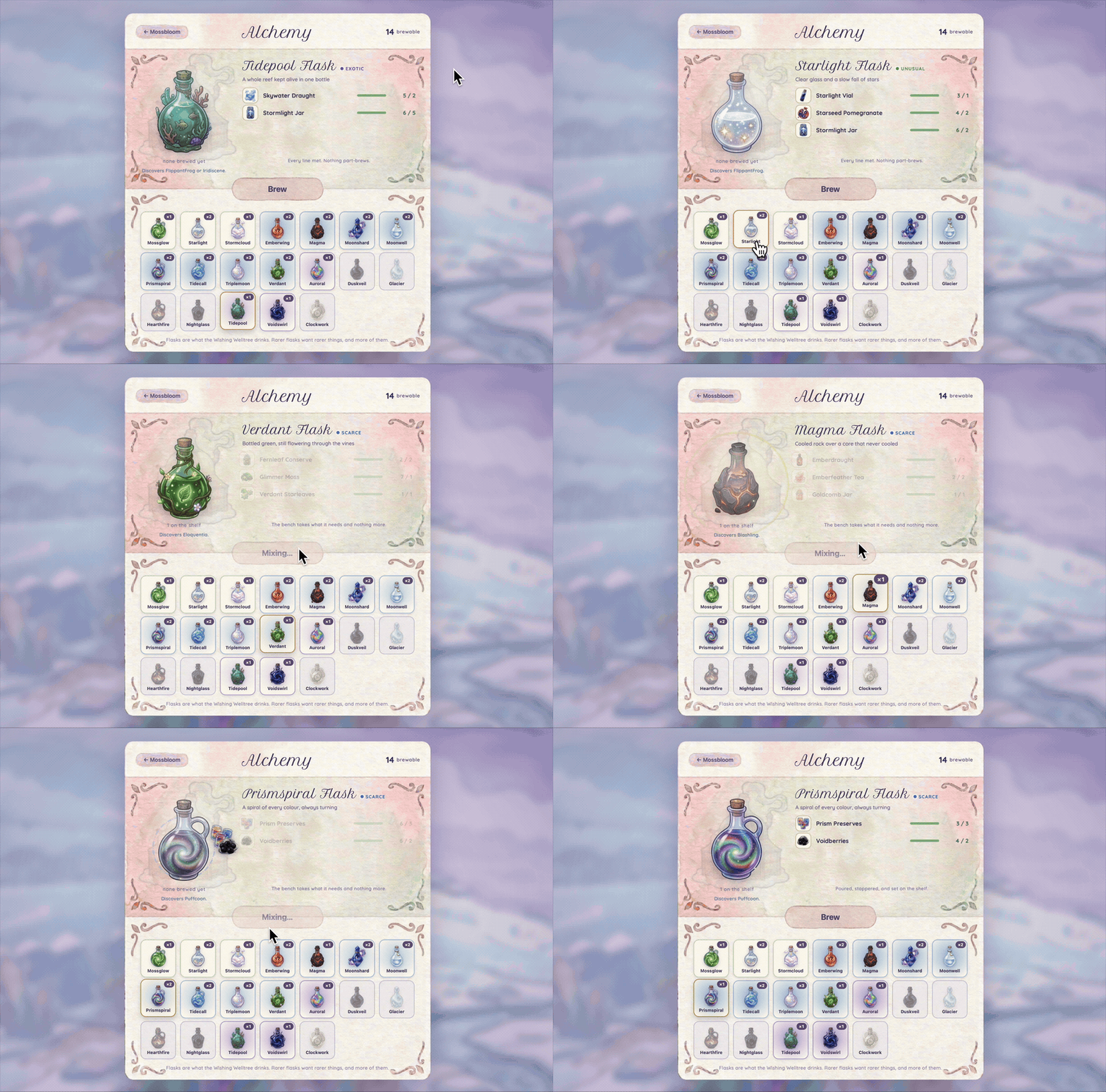
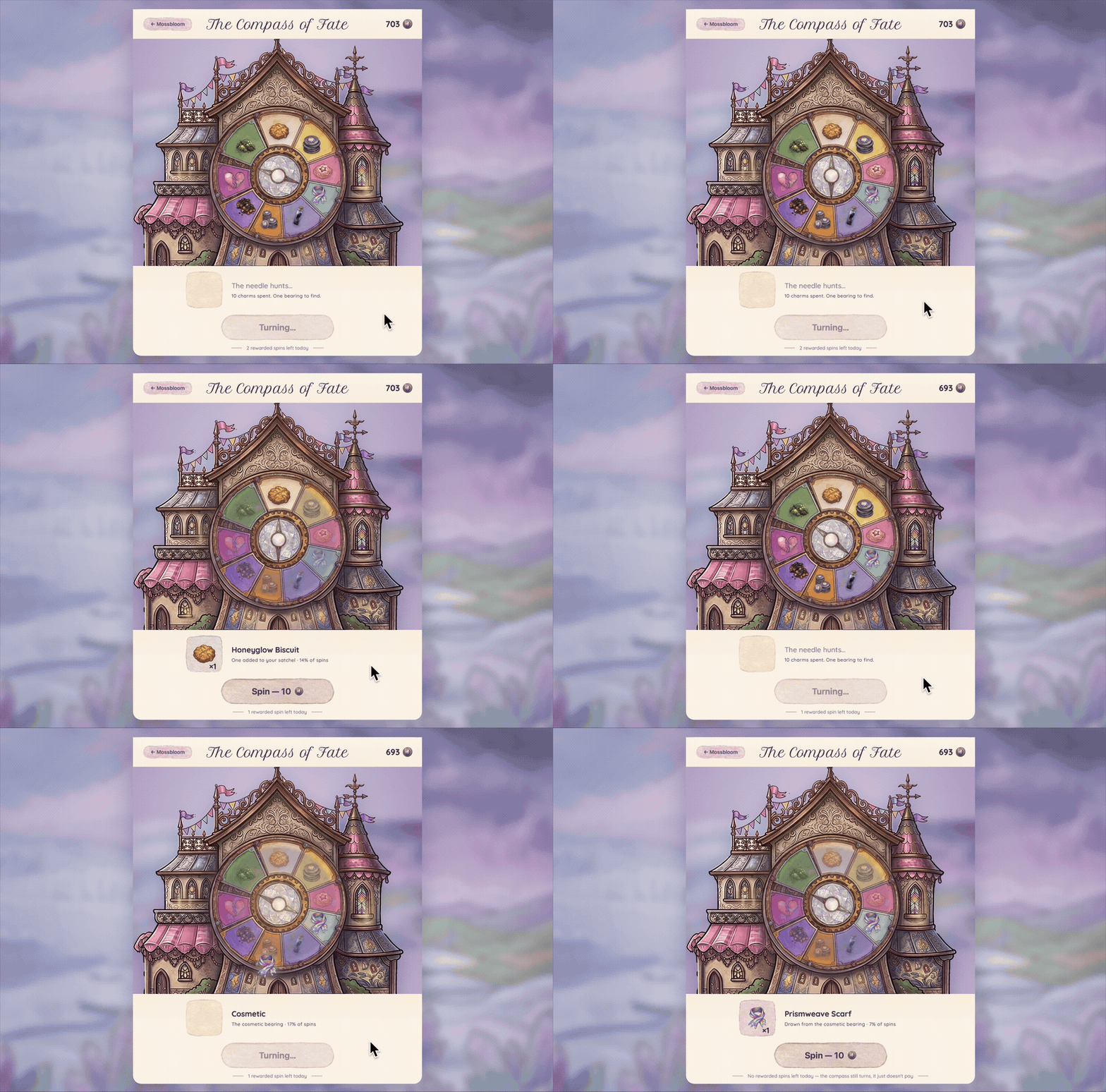
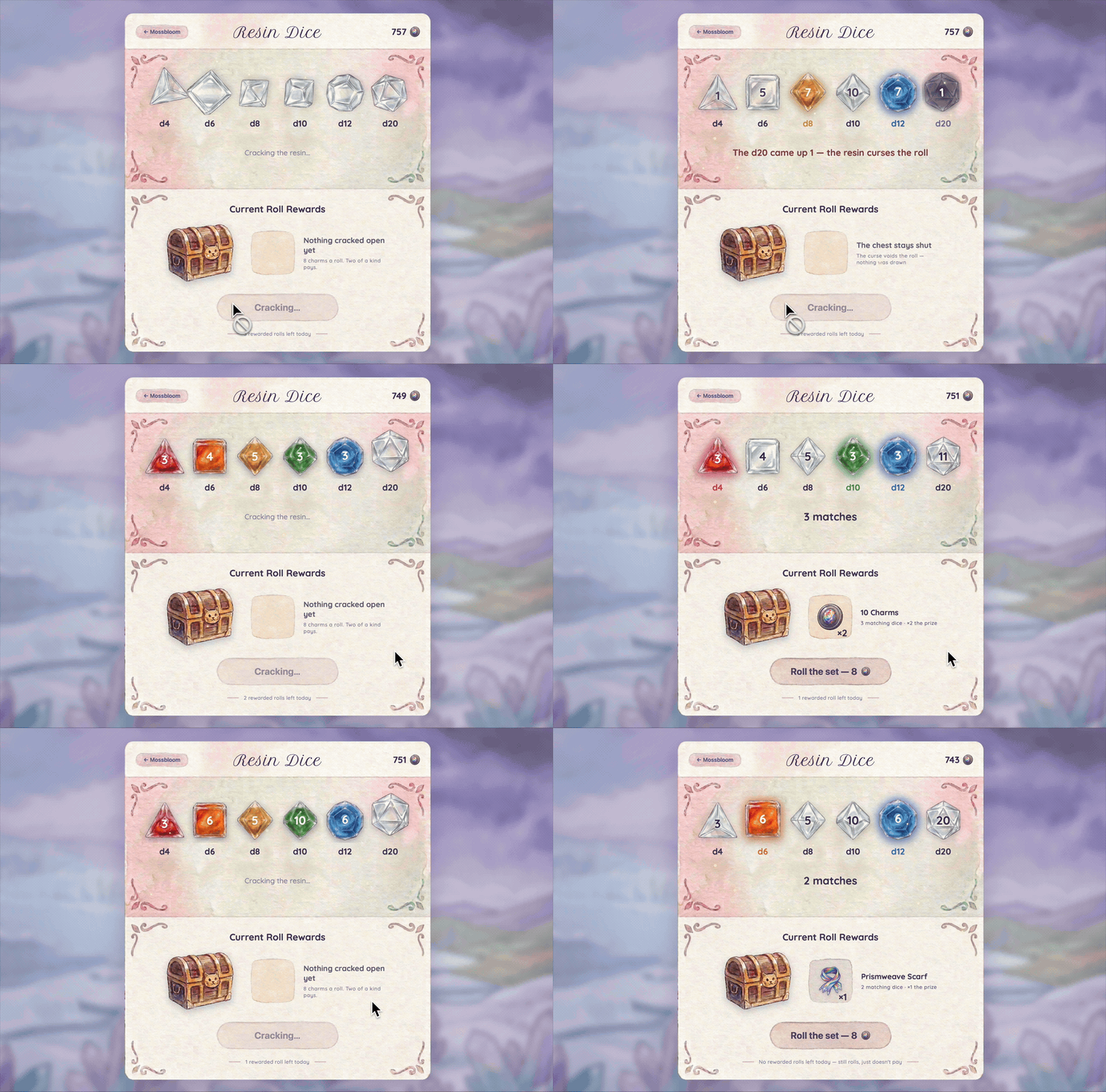
You can play mini-games to earn currency, you can already win prizes (ingredients, equipment, treats) from a spin the wheel (but also lose pet life). You can drop flasks into the wishing welltree to discover new species. You can craft flasks at an the alchemy lab using ingredients. You can roll dice to win more items. There is plenty of room to grow in the starting location of Mossbloom and more in the Glacial Plains and Voidscape. I have not built out pet creation, management, and leveling. But I’ve learned each new feature or system takes about 1 day to build and craft end to end which is rediculous when it comes to game development timelines.
I read a story about a one-man team who built features as requests came in on Twitter for his strategy – I believe it. Of note Tauri can support workflows for HTML5, Desktop, and iOS / Android. However, I think the future requires us to squint real hard about what really is next before commitment.
Aside from this – creating a tool in an hour the moment I need it was blissful. I needed a better way to manage my database, add tags, that showed me visual assets in tandem. I asked for it and I had it along with a database migration strategy. I can build on this as items get currency and pets get abilities.
There is a ton more I’d love to build out and as mentioned this is not a released game, but I’ve cautioned myself that it may only be for fun at this point. The future is unpredictable. What I learned from this experience was eye-opening, but it was also therapeutic for me. A friend told me “They got rid of the A team.” It doesn’t quite apply to me – sadly, I’ve learned in my career how to move on when it makes sense and see myself out after the numbers start coming.
I more like to think of it as – my daughter got the A team dedicated to exclusively making her owls for the last 3 weeks.